Find a hash.
Mint a dog.
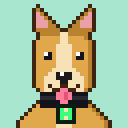
5,000 pixel dogs on Robinhood Chain, mined with proof-of-work. Your CPU or GPU searches for a keccak256 hash below the target. When you find one, you can mint. Nobody gets a free allowlist, not even us.
MINING RIG
TERMINAL
RECENT MINTS
The Kennel
Stake your Hash Dogs and earn ETH every second. Every new mint tops up the reward pool in real time (within about a minute), and the pool streams out over a rolling 6-hour window, shared across every staked dog by rarity weight. Fewer dogs staked means a bigger share per dog. Unstake any time. Rewards are not a fixed yield and depend on mint activity.
HOW REWARDS ARE CALCULATED
- Mint → pool. Every mint pays – ETH. – goes to the Kennel pool, the rest to the treasury. Pushed on-chain within about a minute.
- Pool → stream. New ETH is added to what's left in the pool and the total is re-spread over the next 6 hours:
pool rate / sec = (new ETH + ETH still left) ÷ 21,600 sec - Stream → your dogs. Every second the pool rate is split by weight (Common 1, Rare 2, Epic 4, Legendary 8):
your ETH / sec = pool rate × your weight ÷ total staked weight - Claim. Rewards pile up every second. Claim any time; unstaking also pays out what you've earned.
Not a fixed yield. If nobody mints for 6 hours the stream runs out and rewards pause until the next mint. More dogs staked = smaller share each. If no dogs are staked, the stream is held and resumes to the next staker, so nothing is lost.
IN YOUR WALLET
STAKED
ALL STAKED DOGS
Kennel contract: –
How mining works
Each mint has a public challenge. Your browser repeatedly computes
keccak256(challenge, yourAddress, nonce)
with a different nonce each time. When the result is lower than the current target, you've found a valid hash and can mint. Your address is part of the hash, so nobody can copy your solution from the mempool.
After every mint the challenge changes for everyone. Mining is memoryless: you don't lose progress, since every hash has the same chance.
Difficulty
Difficulty retargets after every mint to keep roughly one dog every 60 seconds across the whole network. If nobody finds a hash for a while, the target eases automatically, so the mint can never get stuck.
Epochs & price
5,000 dogs are split into 9 epochs of 600 (the last has 200). The price doubles each epoch. You pay the price of the current epoch plus gas.
| Epoch | Mint order | Price |
|---|
Which dog do I get?
The dog is drawn on-chain from the remaining pool at the moment you mint, seeded with the L2 block hash. Nobody can pick or snipe a rare one, not even by grinding hashes. Browse all 5,000 and their rarity in Collection.
CPU or GPU?
CPU mining uses Web Workers and works in every modern browser. GPU mining uses WebGPU (Chrome, Edge, Brave, and Safari 26+ on desktop) and is usually 20–200× faster. Keep the tab open and in the foreground: browsers throttle background tabs.
Contract
–